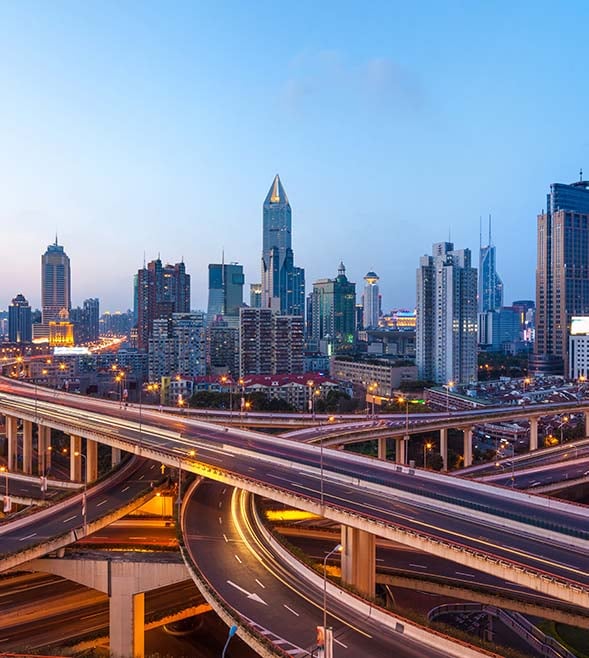
In continuation of the large requirement of capital for infrastructure development, an increase of capital expenditure by 8.9 per cent to INR12.2 lakh crore has been proposed. The thrust is to continue to focus on maintaining stability, adopting a reformative approach and sustaining the economy for India to grow. Towards this, initiatives like developing city economic regions, better transportation networks, access to finance and last mile connectivity have been considered.
As the urban agglomerations are growing rapidly, a positive move is the shift from a 'city-centric' development to a 'region centric' development to improve infrastructure of smaller towns. Developing City Economic Regions is a welcome initiative to harness the power of agglomerations based on the growth drivers of each region. However, the utilisation of the budget of INR 5,000 crore per region over 5 years would need well-structured plans, deeper stakeholder consultations, institutional leadership and actionable implementation plans. Such a utilisation should also be channelised towards emerging areas like development of data centres, multi-modal transport systems and climate and resilience-leading infrastructure in the identified regions.
A sizeable portion needs to be allocated towards urban planning and capacity building at the local Government level for the initiative to be successful through the reform mode.
The momentum of infrastructure growth in the large cities is expected to continue as there will be an unlocking of prime city level real estate through the announcement of recycling of assets owned by Central Public Sector Enterprises and creation of dedicated REITs. Retail investors can now get access to high quality and income generating real assets.
Both freight transportation and passenger transportation have been given equal thrust through the announcement of freight corridors, coastal cargo promotion scheme, modal shift from rail to road and high-speed corridors between cities. These will go a long way in completing and balancing the spatial growth of the CERs. Taken together, all these are to be seen as a direct reduction in the logistics cost while providing an integrated approach to urban development.
The role of the private sector in all these areas is crucial. A key concern of the private sector in infrastructure investment has been the lack of a robust risk sharing mechanism. This has been addressed through the announcement of the Infrastructure Risk Guarantee Fund which will act as a partial credit guarantee to the lenders. The effect of this will result in a larger landscape for the private investment in a wider range of infrastructure sectors. Complemented with this, the INR 100 crore incentive for municipal bonds for single bond of over INR 1,000 crore will bring in more ULBs into the bond market to access finance for their projects. A key factor that will shape the shift towards regional centres is the emergence of Tier 2 and Tier 3 cities as a new frontier for data centres.
They act as a better option compared to tier 1 cities and large metros which face space constraints, huge land costs, high cost of resources and infrastructure constraints. Smaller cities can be an alternative for setting up of decentralised data centres to facilitate Edge computing. This will improve the demand for real estate and increase the potential for private sector participation.
Overall, these measures should be implemented with a robust action plan to create an ecosystem for the CERs combining multi-modal transport systems, last mile connectivity, private sector participation, data centre development and access to finance in order to achieve a balanced and sustainable regional growth in agglomerations.
This article first appeared in The Pioneer on 10 February 2026.
Learn more about how our Urban Infrastructure services can help you