Paving the way for Viksit Bharat 2047

India stands at a decisive inflection point in the evolution of healthcare in India. Over the past decade, the country has built healthcare access at population scale through landmark reforms such as Ayushman Bharat, expanded public health financing, and the creation of a nationally interoperable digital health infrastructure India. With over 55 crore citizens covered under PM‑JAY and more than 1.85 lakh primary care facilities operational nationwide, the foundations for universal healthcare access are firmly in place.

The national priority now shifts from enrolment to outcomes — ensuring continuity of care, long‑term sustainability, and affordable healthcare at scale in India. This transition marks the next phase of healthcare transformation in India, where execution, governance discipline, and responsible adoption of AI in healthcare will determine success. India has the rails, the scale, and the science; the coming decades will be defined by the ability to convert access into measurable health outcomes.

Highlights of the report

1.

Shift from access to outcomes

Strengthening primary care and last‑mile delivery is critical to address rising non‑communicable diseases (NCDs), persistent maternal and child health needs, and systemic gaps in workforce, diagnostics, and continuity of care.

2.

ABDM as the digital backbone

The Ayushman Bharat Digital Mission enables nationwide, consent‑based, interoperable data exchange — establishing trust, data sovereignty, and continuity of care at scale.

3.

AI as an embedded capability

AI functions as a system‑level capability layer, supporting frontline workers, improving coordination, and enabling proactive and predictive care through GenAI and emerging agentic AI.

4.

Governance as the key differentiator

A layered, risk‑graded governance framework ensures AI autonomy scales responsibly, with trust, accountability, and auditability at the core.

5.

Aligned capital and innovation

Public funding, private capital, and GCC‑led innovation are converging to strengthen diagnostics, medtech, digital platforms, and AI‑enabled care delivery.

6.

Path to 2047

India aims to evolve into a fully coordinated, AI‑supported national health system — moving from access at scale to trusted autonomy and global leadership in affordable healthcare.

From access to outcomes

Strengthening the care continuum

As India’s disease burden shifts towards NCDs alongside unfinished maternal and child health priorities, persistent system challenges remain — workforce shortages, fragmented care pathways, uneven diagnostic access, and high out‑of‑pocket expenditure. Primary care and last‑mile delivery have emerged as the most critical coordination layer of healthcare in India.

The effectiveness of India’s healthcare transformation will depend on how well frontline decision‑making, early risk identification, referrals, and follow‑up are institutionalised across geographies to consistently support improving healthcare outcomes.

ABDM

India’s digital nervous system

The Ayushman Bharat Digital Mission (ABDM) serves as the backbone of digital health India, providing the digital public infrastructure required to operationalise continuity of care at scale. With more than 86 crore ABHA IDs created and large‑scale health record linkage underway, ABDM enables interoperable, consent‑based data exchange across public and private providers through platforms such as the Unified Health Interface (UHI) and the Health Information Exchange–Consent Manager.

Designed as a federated and citizen‑controlled ecosystem, ABDM establishes trust, interoperability, and healthcare data privacy in India — not by centralising data, but by standardising its exchange. This digital foundation is the essential rail on which AI‑enabled healthcare capabilities will operate.

AI in healthcare India

A capability layer, not a parallel system

Artificial Intelligence is positioned not as a standalone technology, but as an embedded capability within India’s healthcare architecture. AI in healthcare India enables the system to convert scale into consistency by supporting frontline workers, improving coordination across care levels, and enabling proactive and predictive interventions.

Generative AI is already demonstrating impact through ambient clinical documentation, multilingual patient education, and clinical summarisation — reducing clinician burnout and improving health literacy. The emergence of agentic AI represents the next maturity phase, enabling governed autonomy for follow‑ups, monitoring, triage, and care coordination across the patient journey, while remaining aligned with patient safety and clinical oversight.

Governance and trust as the decisive differentiator

As AI systems shift from assistive to action‑oriented roles, AI governance in healthcare becomes central. India is uniquely positioned to lead responsibly through a layered governance framework that integrates data rights under the DPDP Act, ABDM’s consent architecture, MDR and SaMD regulation, ICMR ethical guidance, and MeitY’s AI Governance Guidelines.

The report advocates a risk‑graded autonomy model, where AI autonomy scales only in low‑risk contexts, with clinicians retaining authority over critical clinical decisions. Trust, accountability, and auditability, not speed of adoption, will define sustainable leadership in AI‑enabled healthcare.

Healthcare innovation and investment at scale

Public funding, private equity and venture capital, and PLI‑driven manufacturing incentives are increasingly aligned with system priorities — flowing into diagnostics, medtech, digital platforms, and AI‑enabled care delivery. This convergence is accelerating healthcare innovation India while reinforcing long‑term system resilience.

At the same time, India’s healthcare GCCs have evolved into global R&D and AI‑first innovation hubs, anchoring the US–India healthcare innovation corridor. These dynamics position India not only as a large market for healthcare solutions, but also as a global reference for affordable, trusted, AI‑enabled systems backed by sustained healthcare investment in India.

The future of healthcare in India

The road to 2047

By 2047, India aims to transition from access at scale to a fully coordinated national health system — where AI‑supported care is universal, autonomy is responsibly governed, capital is patient and productive, and innovation is exportable to the Global South. The journey from access to outcomes, data to intelligence, and intelligence to trusted autonomy will define the future of healthcare in India and shape the nation’s development trajectory.

The foundations are strong. The momentum is real.

Whether India’s healthcare system becomes merely larger or truly world‑leading will depend on the choices made today —choices that will determine the health, longevity, and productivity of over a billion citizens.

North Star: Equitable access. Trusted technology. Sustainable innovation. Better health outcomes for every Indian.

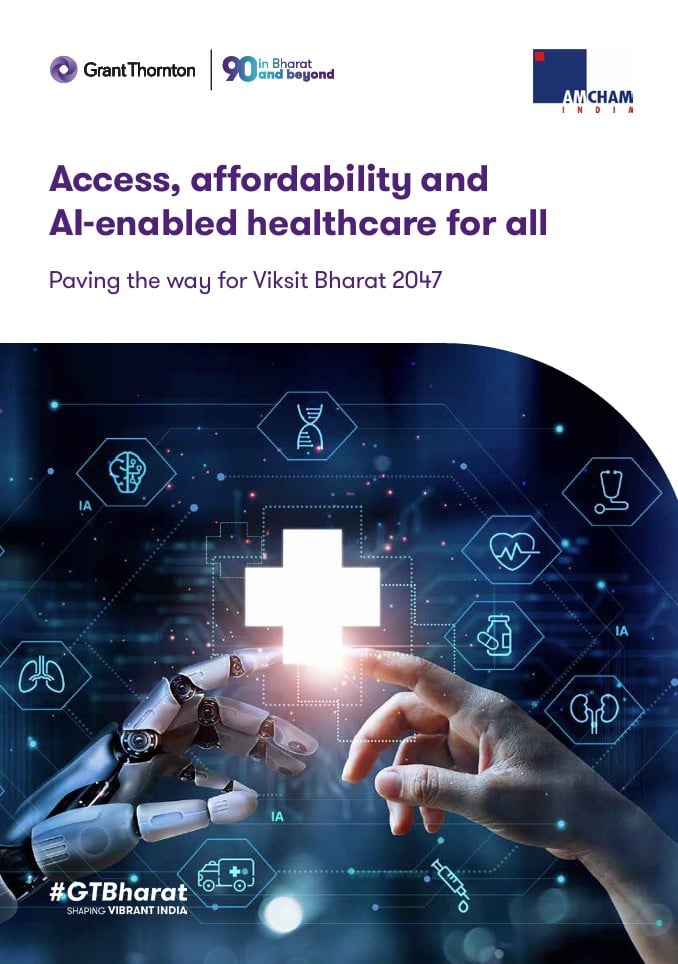
Access, affordability and  AI‑enabled healthcare for all
Download the report

Access, affordability and AI‑enabled healthcare for all

Paving the way for Viksit Bharat 2047