Held from February 16-20 at Bharat Mandapam, the summit - India's flagship under the IndiaAI Mission, drew global leaders to emphasise "AI for People, Planet, and Progress." Unlike prior Western-led events in Bletchley (UK, 2023), Seoul (South Korea, 2024), and Paris (France 2025), it prioritised use cases for the Global South—healthcare access, agricultural yields and governance efficiency.
Outcomes included India's entry into the US-led Pax Silica which will secure supply chains for AI, semiconductors, and critical minerals for "AI Commons" to democratise compute and datasets, establishing compute infrastructure, building indigenous Large Language Models (LLMs), creation of data platform across 20 sectors, talent development, start-up support and projects for AI safety, including bias mitigation and deepfake detection.
AI is transforming India's creaking bureaucracy, where manual processes serve a population larger than the EU and US combined. The India AI Mission, with INR 10,371 crore (USD 1.24 billion) over five years, has deployed 38,000+ GPUs for sovereign compute, enabling tools like MuleHunter. AI (RBI’s initiative) to detect banking fraud and BharatGen, a multimodal LLM for public services.
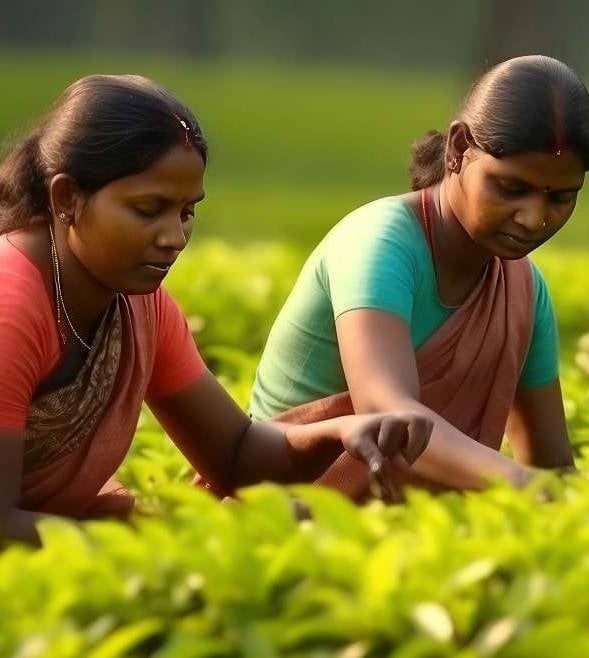
In agriculture, AI-driven Kisan e-Mitra chatbots and satellite analytics cut fertiliser overuse by 40% in pilots, boosting yields 12-30 per cent across 77 crops while curbing emissions. Railways' Kavach 2.0 prevents collisions on 3,500 km of track, and NPCI's systems block INR 25 crore (USD 3 million) in daily UPI scams.
For citizens, AI bypasses infrastructure bottlenecks: e-Sanjeevani telemedicine translates Malayalam queries to Hindi, slashing consult times by 22 per cent; courts auto-generate bilingual judgments, clearing 12,000 backlogs. Bhashini enables real-time translation across 22 languages, while YUVAi equips 8-12 graders with AI skills. Flood forecasting via BrahmaSATARK saved INR 180 crore in Kerala by predicting disasters six days early. These interventions prioritise access over perfection, serving 1.4 billion without Western-style prerequisites like universal broadband.
Western models—the European Union's binding AI Act with risk tiers and GDPR-tied privacy, or the US focus on individual rights—clash with India's realities. The EU bans manipulative AI and mandates bias audits; America emphasises explainability. India, via advisory Principles for Responsible AI (2018) and DPDPA (2023), opts for sector-specific guidelines stressing "AI for All": inclusivity, equality, and societal good over hyper-individualism.
India's diverse datasets (via AIKosh's 3,000+ entries) aim for cultural rootedness, countering Western models trained on English-centric data. Privacy yields to collective utility—think Aadhaar's biometrics enabling UPI for 500 million unbanked—while safety nets like the India AI Safety Institute test for harms.
This "Eastern" paradigm, akin to UAE collaborations, values community harmony and holistic progress, not just autonomy. Overlooking some Western sensitivities—like exhaustive consent for every data point—frees India to deploy AI in law enforcement (e.g., Maharashtra's MARVEL) or predictive policing where speed saves lives amid terror threats and disasters.
Balance comes through indigenisation: Sarvam AI's sovereign LLMs ensure data sovereignty, with 20,000 more GPUs announced at the summit. NASSCOM reports 87% enterprise AI adoption, adding USD 500-600 billion to GDP by 2030. Yet challenges persist—digital divides, talent retention, and fragmented data. India's response: FutureSkills PRIME (3.37 lakh completions) and startup financing.
Concerns raised by civil society groups, activists, and some industry observers about India's relatively light-touch, advisory approach to AI regulation compared to stricter Western frameworks like the EU AI Act. However, for a nation where 65 per cent lack formal banking and doctors serve 834 patients each, ethical absolutism is a straitjacket. India's model evolves via pilots: bias-mitigated healthcare AI, explainable governance tools, under Safe & Trusted AI pillar.
The summit positioned India as a key connector for the Global South, sharing its DPI-AI tools like UPI and Aadhaar with other nations while pushing for open AI models to counter Big Tech monopolies. By the 2027 Geneva summit, India's 180,000 AI-powered startups and 6 million tech jobs could reshape global standards. In the end, practical ethics prevail - rules designed to enable progress rather than hinder it.
In sum, India's AI path forged at New Delhi rejects imported dogma for a sovereign, scaled model. It bets that for 1.4 billion aspirations, bold deployment with calibrated safeguards outpaces cautious perfectionism. The world, especially the South, watches closely.
This article first appeared in The Week on 12 March 2026.
Learn more about how our Public Sector Advisory services can help you