Learn more about how our Energy & Renewables services can help you

Will Russian oil be economically viable for India if Trump tariffs return?
India's search for the optimal crude import mix is a constant balancing act.
For more updates follow Grant Thornton Bharat on WhatsApp

By: Pradeep Singhvi
27 Aug 2026 6 min read
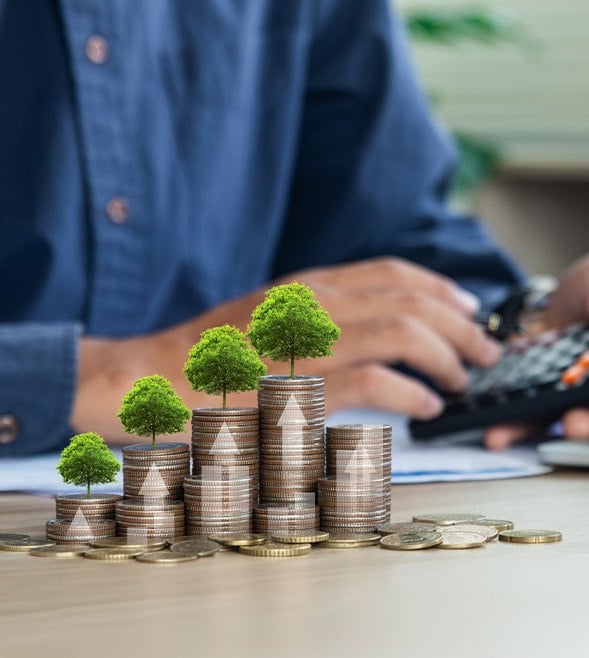
For India, this is not a debate between growth and green transition. That debate is outdated. The real question is whether India can finance a cleaner, more resilient and more competitive growth model without compromising energy security, industrial expansion or social equity.
The world has finally started acknowledging the scale of the problem. The Baku to Belém Roadmap, presented by the COP29 and COP30 Presidencies, aims to mobilise at least USD 1.3 trillion annually in climate finance for developing countries by 2035. It recognises that climate action cannot remain trapped in speeches, declarations and negotiation rooms; it must reach projects, balance sheets and communities.
India stands at the centre of this challenge. The country has already committed under its 2031–35 NDC to reduce emissions intensity of GDP by 47 per cent from 2005 levels, achieve 60 per cent cumulative electric power installed capacity from non-fossil sources, and create an additional 3.5–4 billion tonnes of CO₂ equivalent carbon sink through forest and tree cover by 2035.
But ambition without finance is only a press release.
India’s transition will not be cheap. The draft framework for India’s Climate Finance Taxonomy notes that the country requires around USD 2.5 trillion by 2030 to meet its NDC targets, while energy transition investment alone is estimated at nearly USD 250 billion annually till 2047, excluding additional costs such as EV infrastructure and new industrial demand.
The uncomfortable truth is that India is largely financing its climate transition by itself. The Economic Survey 2025–26 states that around 83 per cent of India’s mitigation finance and 98 per cent of adaptation finance comes from domestic sources. It also highlights that climate finance remains skewed towards mature sectors such as solar, wind and energy efficiency, while adaptation, MSMEs, urban infrastructure and hard-to-abate industries remain underfunded.
This is the central contradiction of global climate politics: developing countries are asked to move faster, but they are financed slower.
India should therefore stop treating climate finance as a narrow environmental issue. It is now a competitiveness issue, a trade issue, a banking issue, a state-capacity issue and a national security issue.
Europe’s Carbon Border Adjustment Mechanism is a warning signal. Indian steel, cement, aluminium and other carbon-intensive exports will increasingly face carbon-linked scrutiny in global markets. The cost of carbon will soon show up not only in environmental compliance but also in export margins, credit ratings, insurance premiums and market access. Recent reporting on EU carbon border rules has already flagged pressure on Indian iron and steel businesses.
In simple terms, carbon inefficiency is becoming a trade liability.
That is why India’s climate finance strategy needs five hard shifts.
First, India needs a national climate finance platform that moves beyond announcements. The platform should aggregate projects from states, cities, MSMEs and industries; standardise documentation; provide credit enhancement; and connect them with banks, pension funds, insurers, development finance institutions and global climate capital. The problem is not only lack of money, but the lack of bankable, de-risked and investment-ready pipelines.
Second, India must build a serious transition finance architecture. A Western-style “green or dirty” classification will not work for India. Our economy includes coal-linked power, steel, cement, fertilisers, transport, MSMEs and fast-growing urban demand. The draft taxonomy rightly recognises that transition pathways must support mitigation, adaptation and hard-to-abate sectors while preventing greenwashing.
Third, climate finance must reach MSMEs. Large corporations can issue green bonds, hire consultants and manage ESG disclosures. A small foundry, textile unit or auto-component supplier cannot. Yet these firms sit inside global value chains. Without concessional credit, technology support, energy audits and pooled decarbonisation facilities, India’s MSMEs may become collateral damage in the new carbon economy.
Fourth, adaptation finance must be treated as productive investment, not disaster relief. Heat-resilient cities, flood management, water security, climate-resilient agriculture, cooling infrastructure and coastal protection are not welfare expenses. They are growth protection assets. Every rupee spent before a climate shock can save multiple rupees after it. India’s climate finance debate remains too mitigation-heavy; the next phase must make resilience bankable.
Fifth, India must deepen rupee-denominated green capital markets. Sovereign green bonds are a good signal, but they are not enough. Budget documents show proposed requirements of around INR 30,941 crore under schemes eligible for Sovereign Green Bond financing in BE 2026–27, while FY 2025–26 mobilisation through SGrBs was INR 15,000 crore. That is progress, but not scale. India needs municipal green bonds, state climate finance facilities, blended finance funds, infrastructure investment trusts, credit guarantees and climate-linked priority lending that can mobilise domestic institutional capital at depth.
Regulation is also moving in the right direction. The RBI’s green deposit framework requires regulated entities that raise green deposits to follow prescribed financing rules, including disclosure and allocation discipline. But regulation must now shift from disclosure to deployment. Climate risk reporting is important; climate capital allocation is decisive.
The new climate economy will reward countries that can reduce the cost of capital for clean infrastructure, industrial transition and resilience. It will penalise countries that treat climate finance as a conference subject.
India should be clear in global forums: climate justice does not mean charity. It means affordable capital, technology access, fair risk-sharing and reform of a global financial architecture that still prices developing-country risk too harshly. The Economic Survey is correct in pointing out that international public finance to developing economies remains limited and that the global financial architecture carries a persistent bias in favour of developed countries.
At the same time, India cannot wait for the world to become fair. We need to build domestic capability while negotiating global responsibility. That means stronger project pipelines, sharper taxonomy, cleaner data, better risk guarantees, deeper bond markets and transition pathways that protect both industry and workers.
The real test of climate finance is not whether it sounds green. The test is whether it lowers the cost of capital, protects exports, reduces climate vulnerability, creates jobs, modernises industry and strengthens India’s development pathway.
For India, climate finance is not a side chapter of environmental policy. It is the balance sheet of Viksit Bharat.
The countries that finance the transition will shape the rules of the next century. India must ensure it is not merely adapting to those rules, but helping write them.
This article first appeared in the ET Energy World on 27 August 2026.
India's search for the optimal crude import mix is a constant balancing act.
Critical minerals in India have moved from being a niche mining concern to a strategic national priority.
Energy security has emerged as a defining pillar of economic resilience, industrial growth, and geopolitical stability.