Newsletter
Insurance Insights: January to July 2026
India's insurance sector witnessed several regulatory and industry developments during the first half of 2026.
For more updates follow Grant Thornton Bharat on WhatsApp

More working Indians feel confident about their finances, but that confidence does not necessarily mean they are better prepared to handle financial setbacks. Slow income growth, rising living costs, dependence on salaries and insufficient retirement planning continue to leave many vulnerable.
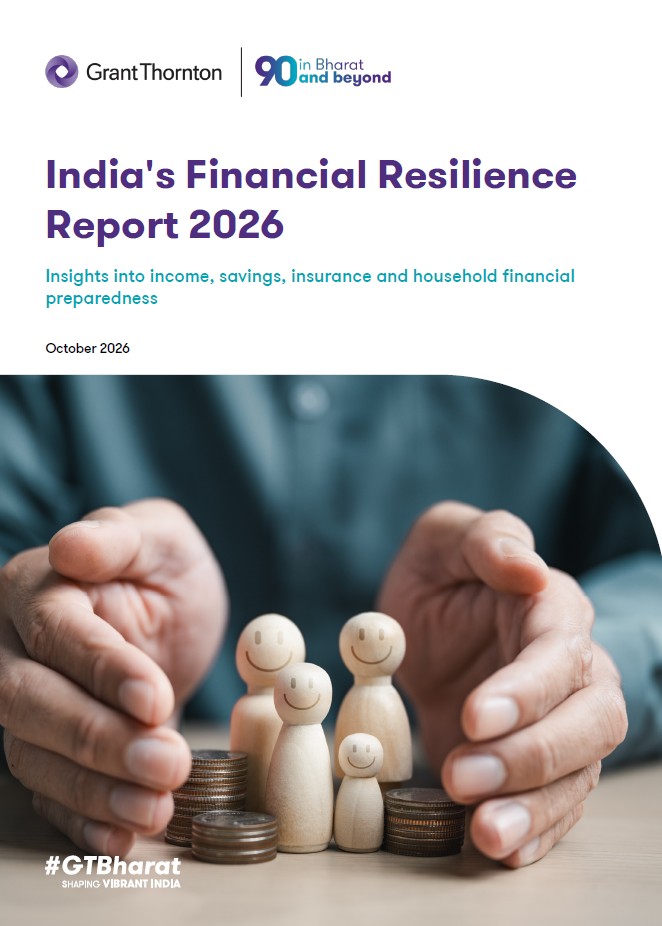
Grant Thornton Bharat’s “India’s Financial Resilience Report 2026” explores how people feel about their finances and how they spend, save, protect themselves financially and plan for the future. It draws on responses from 528 people across India, collected between November 2025 and February 2026.
The survey largely reflects the experiences of a young, urban and salaried workforce:
Nearly 62% of respondents report annual income growth of 4–12%. At the same time, 62% also believe that their income increases will not be sufficient to keep pace with future inflation. The concern is particularly pronounced among respondents aged 25–34, 70% of whom believe that income growth may not offset future price increases.
Perceived compensation gaps add to this pressure. Although nearly half of the respondents consider themselves highly skilled, 82% believe their compensation does not adequately reflect their skills. This view remains broadly consistent across respondents who rate themselves as intermediate, highly skilled or expert.
Income diversification also remains limited. Salary is a source of primary income for 91% of respondents, while only 29% earn income from investments. A large share of women, approximately 69%, have no secondary income source.
The findings also point to active financial management among respondents. Around 38% always prepare a monthly budget, while approximately 95% are confident or somewhat confident about managing monthly expenses without using a credit card. Most respondents spend up to half of their income on rent or equated monthly instalments, utilities and household expenses.
Family responsibilities remain an important part of financial planning:
Around 16% of respondents say they spend nothing on insurance, medical bills or parental care. Of these, 91% earn less than INR 15 lakh a year. The same income group accounts for 97% of those who are unable to save. These findings suggest that tight budgets leave many with little room to save or pay for financial protection.
Most respondents have life and health insurance. Around 61% have life insurance cover ranging from INR 50 lakh to INR 1 crore, and 59% have health cover ranging from INR 25 lakh to INR 50 lakh. Term life insurance is the preferred option for 80% of respondents. However, 21% have less than INR 20 lakh in life cover. Since most respondents have at least one dependent, this amount may fall short.
Most respondents recognise the importance of emergency savings. Around 84% have fully or partially funded emergency reserves. However, 83% say that these savings would sustain them for less than one year if their income stopped.
This limited runway reflects a combination of fixed household obligations, moderate income growth and dependence on one source of income. An extended interruption to income could therefore increase financial stress or reliance on borrowing.
Retirement readiness in India remains a concern, especially for younger respondents. Around 83% say they are not financially prepared for retirement, rising to 92% among those under 34. Even those who regularly save or invest may still have some way to go towards building a retirement fund.
Mutual funds are the most popular investment choice, held by 82% of respondents, while 23% invest directly in shares. Around 61% say their portfolios consist mainly of high-risk investments, including stocks, cryptocurrencies and mutual funds. Their decisions are largely shaped by domestic factors, with 73% saying international policies have little influence on where they invest.
Artificial intelligence (AI) is also beginning to support investment decisions. Around 69% occasionally use AI tools for market insights or recommendations, although only 3% use AI-based platforms actively. In the workplace, 51% expect AI to change how they work and believe they may need to adapt or reskill. Another 35% believe it will create new opportunities.
Around 63% of respondents describe themselves as very confident and financially stable. Yet limited income diversification, short emergency-fund runways, protection gaps and low retirement preparedness point to underlying vulnerabilities.
The report highlights an important distinction: financial confidence reflects how individuals view their present position, while financial resilience depends on their ability to withstand prolonged uncertainty. Closing the distance between the two will require greater focus on preparedness, protection and long-term financial sustainability.

India's insurance sector witnessed several regulatory and industry developments during the first half of 2026.

Ind AS 117, Insurance Contracts, introduces a comprehensive principles-based framework for the recognition, measurement, presentation and disclosure of insurance contracts, establishing a globally consistent approach to accounting for insurance liabilities.

Analyse M&A and investment activity in India’s financial services sector for Q1 2026, with insights on banking, fintech, deal trends and evolving market dynamics.