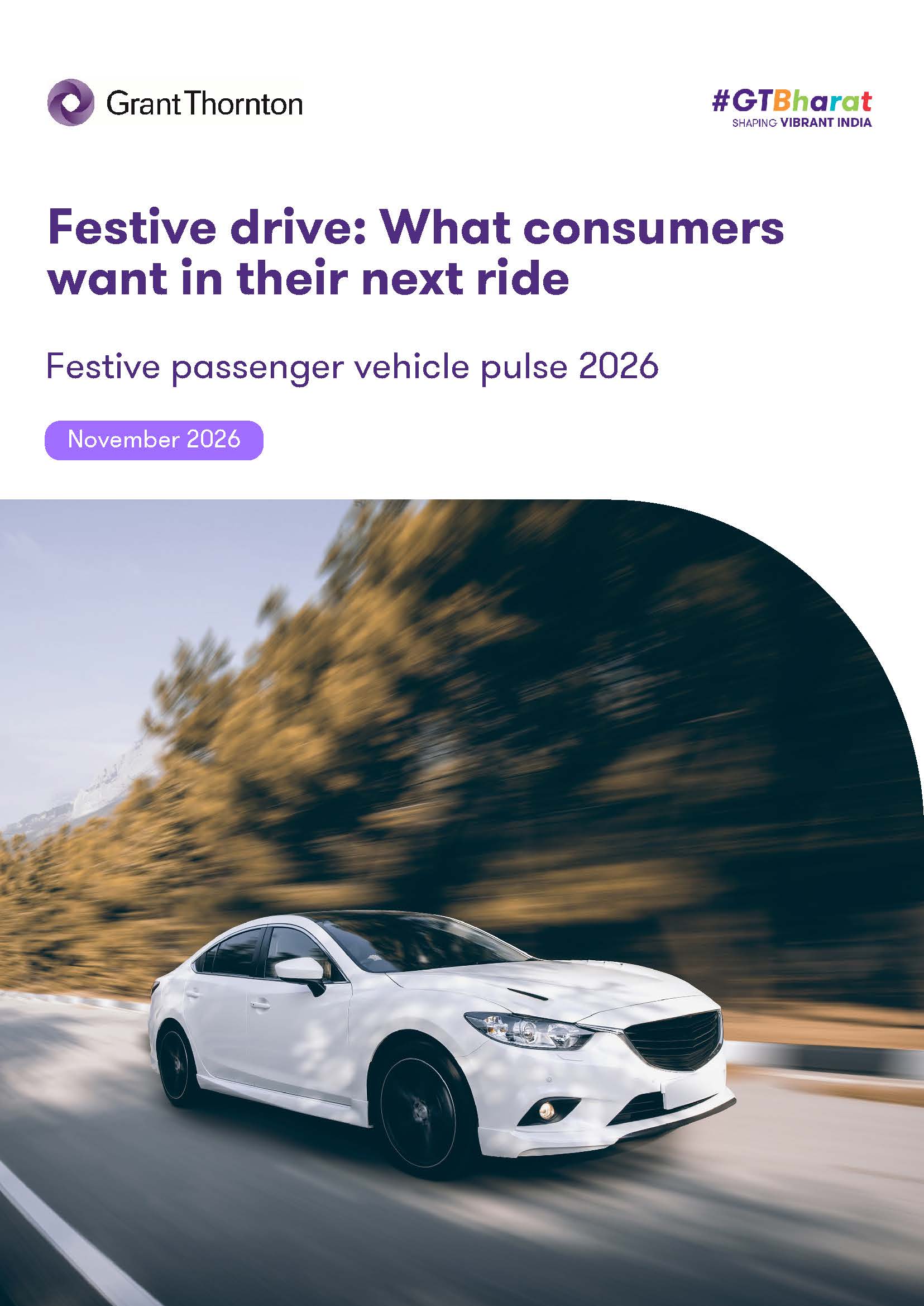
India’s passenger vehicle market enters the 2026 festive period with strong momentum, a widening range of powertrains and changing expectations around vehicle ownership.

Grant Thornton Bharat’s latest report examines passenger vehicle trends in India, including purchase intent, vehicle and powertrain preferences, financing choices, sustainability considerations and customer experience.

The findings draw on insights from more than 1,300 consumers across age groups and 500 dealers across regions, bringing together perspectives from both sides of the purchase journey. The report also identifies directional shifts in Indian car buying behaviour from 2025.

What is shaping festive passenger vehicle demand in India in 2026?

Vehicle purchase intent in India is cautious, but consideration is building

Nearly one in four respondents are likely or definitely planning a festive-season purchase, while a further 33% are exploring available options.

Replacement and upgrade remain the strongest purchase triggers, cited by 49% of respondents. Consumers are seeking tangible improvements in safety, technology, efficiency and ownership economics.

Manufacturers and dealers can convert this festive vehicle demand in India by presenting a clear ownership proposition that connects vehicle price, financing, fuel efficiency, safety, features and long-term costs.

Why are SUVs the preferred vehicle choice among Indian consumers?

Sport Utility Vehicles (SUVs) preference among Indian car buyers remains, selected by 58% of respondents, although consideration has declined from 64% in 2025.

Hatchback consideration has increased from 10% in 2025 to 16%, indicating renewed interest in smaller, more accessible formats offering relevant safety, technology and fuel-efficiency features.

Across themes, consumers are balancing aspiration with affordability, safety, efficiency, technology and ownership economics, making the purchase decision more considered and multidimensional.

Are hybrid vehicles becoming the preferred fuel option in India?

Hybrid vehicles lead consumer preference at 37%, broadly stable against 38% in 2025. Electric vehicle consideration has increased from 21% in 2025 to 23% this year, indicating evolving hybrid vehicle adoption in India.

Petrol accounts for 31% of consumer preference, while diesel remains the least preferred mainstream option at 9%.

These findings indicate that consumers are balancing efficiency and lower-emission technologies with charging access, infrastructure availability and confidence in long-term ownership.

Clear comparisons covering running costs, charging or refuelling access, warranties, service capability and resale expectations can help consumers evaluate the widening choice of powertrains.

What factors influence passenger vehicle buying decisions the most?

Safety is the leading purchase consideration, identified by 57% of respondents, followed by fuel efficiency at 52% and price at 47%.

Features and technology influence 43% of respondents, making these the leading passenger vehicle buying decision factors.

For OEMs and dealers, the findings call for an integrated value proposition rather than price-led communication alone. Product comparisons should connect safety, efficiency and technology with tangible ownership outcomes, while dealership conversations should reinforce these benefits through test drives, transparent cost explanations and relevant variant comparisons.

Passenger vehicle research and buying journey in India

Digital media and content creators are the leading sources of influence during vehicle research, cited by 45% of respondents. Friends and family influence 39%. However, dealerships remain central to the conversation. Almost every expected purchase journey includes a dealership interaction, while 75% of respondents would not purchase without a physical test drive.

Manufacturers and dealers therefore need a connected customer journey, with consistent product, pricing and ownership information across digital channels and physical dealerships.

Future of vehicle ownership in India

Nearly seven in 10 respondents consider environmental sustainability extremely or somewhat important when choosing their next vehicle. The findings indicate that consumers often connect sustainability with practical benefits, including fuel efficiency, hybrid technology, lower emissions and potential long-term savings.

However, consumer understanding of the regulatory and fuel transition remains limited. Only 33% of respondents are aware of Corporate Average Fuel Efficiency (CAFE) Phase III.

Meanwhile, 41% associate E20-compatible vehicles with engine or maintenance concerns, highlighting the need for clear information about compatibility, warranties, servicing requirements and expected performance.

From festive vehicle demand in India to conversion

As vehicle technologies, powertrain choices and ownership models expand, consumers increasingly need clarity on affordability, running costs, infrastructure readiness and long-term value. Manufacturers and dealers that simplify decision-making, strengthen dealership capability and communicate a consistent ownership proposition will be better placed to convert festive interest into sustainable demand.

Explore India passenger vehicle trends
Read the report

Explore India passenger vehicle trends

Driving growth and transformation across Automotive & EV