The Indian seed industry is entering a new phase as agriculture focused on productivity, sustainability, climate resilience and innovation. Seeds are no longer viewed simply as agricultural inputs; they play an important role in food security, climate adaptation and improving farm productivity. As the global seed sector increasingly focuses on genetics and advanced breeding technologies, India is well positioned to strengthen its role. The country’s scientific capabilities, diverse agro-climatic conditions, growing private-sector participation and established seed production base provide a strong foundation.

India’s opportunity extends beyond domestic demand. With a large scientific talent pool, established production clusters and strong integration into global seed value chains, the country has the potential to emerge as a regional hub for seed research, production and exports serving markets across Asia and Africa.

Global and India

Shifting focus of seed sector

Global seed trade

The global seed industry is increasingly creating value through innovation rather than production volume alone. While cereals and oilseeds account for most seed volumes, vegetable and horticulture seeds contribute a much larger share of trade value due to advanced genetics, hybridisation and higher commercial value.

Global competitiveness is now shaped by climate resilience, innovation capabilities, breeding technologies and strong research ecosystems. Beyond production scale, success depends on breeding programmes, intellectual property protection, certification standards and efficient distribution systems. As demand for improved seeds rises in emerging markets such as India, new opportunities are opening for innovation-led growth.

India seed industry and its growing global relevance

India is the world’s fifth-largest seed market, supported by higher seed replacement rates, growing adoption of hybrid seeds and wider use of improved varieties. The country combines a large domestic market with strong breeding capabilities, established production infrastructure and diverse agro-climatic conditions, supporting a broad range of crops.

Public institutions continue to focus on crops critical to food security, while private companies have driven innovation in hybrids, vegetables and other high-value segments. Together, they provide a strong platform for India to expand its participation in higher-value global seed markets.

Seed value chain: From genetics to farmer adoption

India’s competitiveness is underpinned by a seed value chain that spans research, breeding, seed multiplication, processing, certification and distribution. Specialised seed-production regions support different stages of development, from variety creation to commercialisation. The process begins with germplasm development and trait discovery and extends through breeding, testing, registration, multiplication and farmer adoption. 

India hosts a complete seed value chain encompassing:

1.

Research and germplasm development

2.

Breeding and varietal improvement

3.

Seed multiplication and production

4.

Processing, certification and distribution

Seed innovation in India driving the next frontier

Seed innovation in India is being shaped by advances in genomics, biotechnology and digital technologies, alongside stronger collaboration across the research ecosystem. Public institutions, agricultural universities, international research organisations and private companies all contribute to varietal development, technology transfer and commercialisation.

The challenge now is to accelerate the journey from research to market. Shorter innovation cycles, stronger commercialisation pathways and wider adoption of advanced breeding tools will be critical to developing improved varieties more efficiently.

Plant breeding technologies transforming agriculture

Modern plant breeding technologies are changing how improved varieties are developed and commercialised. Breeding cycles that once took 10–15 years are being shortened through molecular breeding, genomic selection, digital phenotyping and biotechnology.

Technologies such as marker-assisted selection, speed breeding, genomic platforms, artificial intelligence-based analytics and seed enhancement solutions are helping breeders improve precision, accelerate development and deliver better-performing varieties.

Agricultural biotechnology and gene editing in agriculture

Agricultural biotechnology is transforming breeding into a more precise and data-driven process. Molecular breeding, genomic prediction and targeted trait development enable researchers to identify desirable characteristics earlier and improve breeding efficiency.

Gene editing is attracting significant attention because of its ability to target traits linked to drought tolerance, disease resistance, nutrient-use efficiency and climate resilience. Combined with speed breeding and genomic selection, it has the potential to accelerate genetic gain and make breeding programmes more targeted and predictable.

Innovation in seed systems is increasingly shifting from trait selection to trait design, with breeding becoming more targeted, predictable and efficient.

Climate-resilient seeds for sustainable agriculture

Climate change is increasing pressure on agricultural systems through rising temperatures, erratic rainfall, droughts, floods and pest outbreaks. As these challenges intensify, climate-resilient seeds are becoming increasingly important for food security and sustainable agriculture.

Breeding programmes are focusing not only on higher yields but also on stability under difficult growing conditions. Advances in genomics, molecular breeding and data-driven selection are helping develop varieties better suited to drought, heat, flooding, salinity and pest pressures.

However, improved genetics alone are not enough. Effective seed systems that connect breeding, multiplication, certification and farmer access are equally important to ensure climate-resilient varieties reach farmers at scale.

Seed technology and the agricultural innovation ecosystem

The development of advanced seed technology is taking place within a broader agricultural innovation ecosystem that brings together research institutions, startups, technology providers, public organisations and private seed companies.

Startups are contributing through digital phenotyping, breeding analytics, biological solutions, seed traceability and precision agriculture. The long-term strength of the sector will depend on how effectively innovation ecosystems convert scientific advances into solutions that can be adopted by farmers.

Seed regulatory framework and market access

The regulatory framework plays a key role in determining how quickly seed technologies and varieties move from research to commercialisation. Seed systems operate within a complex environment that includes quality standards, certification requirements, intellectual property protection, phytosanitary controls and trade regulations.

India’s regulatory architecture seeks to balance innovation, quality assurance, farmer interests and market access. Improving efficiency, traceability and alignment with international standards can help strengthen competitiveness and support greater participation in global seed trade.

The defining challenge is not only to develop better seeds, but to ensure that regulatory systems are able to move those seeds efficiently, reliably and at scale.

Public-private partnerships in agriculture accelerating innovation

Public-private partnerships are becoming increasingly important in moving scientific advances from research to application. Public institutions bring research expertise, while private companies contribute product development, commercialisation and distribution capabilities.

India already has a strong public research base and an established private seed sector. Strengthening collaboration, licensing mechanisms and commercialisation pathways can help accelerate innovation and support the development of resilient and market-oriented seed systems.

The future of India’s seed industry

The future of India’s seed industry will be shaped by innovation, climate resilience, export competitiveness and collaboration. The country possesses many of the ingredients needed to become a leading regional hub for seed innovation and supply, including scientific capability, diverse agro-climatic conditions, established production systems and strong public-private participation.

Realising this opportunity will require faster innovation, wider adoption of advanced breeding technologies, greater use of gene editing, a supportive regulatory environment and stronger collaboration across the ecosystem. By strengthening these areas, India can expand its role in global seed trade while contributing to more sustainable and climate-resilient agriculture across Asia and Africa.

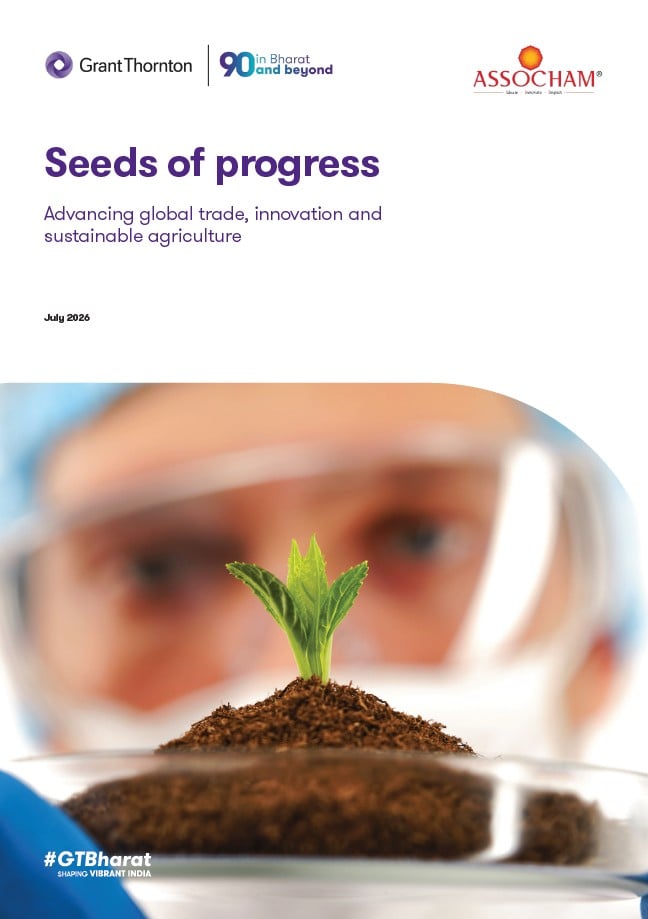
Seeds of progress
Download the report

Seeds of progress

Advancing global trade, innovation and sustainable agriculture