
The country now has one of the largest refrigerated storage capacities in the world, but storage alone does not create an effective Indian cold chain infrastructure. The next stage should link farms, packhouses, refrigerated transport, logistics hubs, and markets through continuous temperature control and a record accompanying each consignment. This FICCI–Grant Thornton Bharat report examines structural deficiencies impeding the sector, the investment required to eliminate them, and the policy, technological, and sustainability measures that could transform the cold storage infrastructure in India into an integrated national network by 2047.

Key highlights

India’s cold chain market: Strong capacity, weak connectivity

The Indian cold chain market serves a vast perishable economy, including 370.7 million tonnes of horticultural produce; 247.9 million tonnes of milk, meat, and seafood; pharmaceuticals; processed food; and the fast-growing quick commerce sector. Yet only a small share of food moves through an organised cold chain. Capacity is concentrated by crop, geography, and season, with more than half located in Uttar Pradesh and West Bengal. The principal challenge is not simply adding cold rooms but creating cold chain logistics in India that maintain product condition from the first point of cooling to the final buyer.

Sources of demand in the Indian cold chain: Output and temperature band

Five sectors, each large, each needing a different temperature. One chain has to serve them all.

Source of demand Annual scale What sits behind it Temperature needed
Fruit, vegetables, and other horticulture
370.74 million tonnes  a year (2024-25)
Fruits 117.65, and vegetables 217.80 million tonnes, plus spices and flowers
0 to +4 °C for most produce; +10 to +15 °C for chilling-sensitive crops; −18 °C frozen
Dairy
247.87 million tonnes of milk a year (2024-25)
World’s largest producer, at 485 g per person per day
+2 to +4 °C chilled; −18 °C frozen
Meat, poultry, and seafood
10.50 million tonnes of meat a year (2024-25)
Poultry 5.18 million tonnes, 149.11 billion eggs, seafood exports of INR 62,408 crore on 16.98 lakh tonnes
0 to +4 °C chilled; −18 to −25 °C frozen
Pharmaceuticals and life sciences
USD 30.47 billion of exports (2024-25)
A major supplier of generic medicines worldwide, and to UNICEF vaccine procurement
+2 to +8 °C; −20 to −80 °C for biologics; −196 °C for cell and gene therapies
USD 3.34 billion quick
commerce GMV (2023- 24), heading to USD 10 billion by 2029
Dark stores, frozen and chilled ready meals
+2 to +4 °C chilled −18 °C frozen

What are the key gaps in India’s cold chain infrastructure?

India’s cold chain has a strong middle but weak ends. At the farm gate, field heat is often not removed quickly. Grading and packing occur without adequate cooling, and small consignments cannot support a reefer vehicle on their own. At the market end, urban fulfilment has expanded rapidly, but the upstream supply may have travelled ambient for its first hundred kilometres. Reverse logistics for rejected, returned, or temperature-exposed products is also underdeveloped. These breaks reduce shelf life, weaken quality, and contribute to post-harvest food losses.

Why first-mile cold chain connectivity matters

The India Cooling Action Plan highlights the scale of the imbalance. Cold storage is already near the planned capacity for 2037–38, while pack-houses, reefer vehicles, and ripening chambers remain far below their targets. The highest-value intervention is first-mile cold chain connectivity. This includes modular pre-cooling near production clusters, feeder pack-houses that create batch identity, and pooled refrigerated transportation that aggregates small loads. India’s dairy network demonstrates this model. A first cold point close to the producer, organised aggregation, and an assured buyer have helped keep milk losses below those seen in many horticultural crops.

Progress against India cooling action plan targets, 2037-38

Cold storage is most of the way to its target; everything that moves produce to and from that storage has barely started.

84%
Cold storage

40.22 Mn MT / 48 Mn MT

1.05%
Pack houses

1,312 / 1,25,000 units

4.85%
Reefer vehicles

19,400 / 4,00,000 units

11.6%
Ripening chambers

1,630 / 14,000 units

How can technology improve cold chain traceability?

Cold chain traceability should begin when a batch is first graded and cooled and continue across every handover. The report recommends a single machine-readable record that contains batch identity, required temperature band, time-stamped readings, custody transfers, and any excursions. Existing sensors, condition-monitoring labels, and vehicle telematics can make breaches visible. Predictive maintenance can identify equipment failure before temperatures move out of range. The opportunity is to add this record to the Unified Logistics Interface Platform rather than build another national system. Technology creates value only when alerts have a named owner and a defined action.

Where are the cold chain investment opportunities?

The strongest cold chain investment opportunities lie in assets that connect existing storage to production and consumption: pre-cooling facilities, integrated pack-houses, pooled reefer fleets, multi-temperature hubs, cross-docks, and cold blocks at multimodal logistics parks. However, grants alone cannot meet the estimated capital requirement. Bankability will depend on multi-commodity facilities, complementary seasonal demand, contracted utilisation, and anchor off-take from processors, retailers, or exporters. Attaching verified temperature histories and commodity grades to warehouse receipts could also extend working capital financing to perishables.

Policy, sustainability and the roadmap to 2047

India already has extensive policy support, but schemes are spread across ministries and frequently fund individual assets rather than operating lanes. A single application route, common technical standards, and outcome-linked support can improve convergence. New infrastructure should be green by design, using efficient insulation and compressors, solar or hybrid power, low-warming refrigerants, reusable packaging, and better load consolidation. The roadmap to 2047 begins by closing the first mile, then integrating cold capacity into logistics parks and common standards, and finally operating a visible national cold chain grid. The aim is a connected, accountable, and climate-smart system that improves farmer realisation, food security, export competitiveness, and public health.

Vision 2047: The national cold chain grid in three horizons

Each horizon is defined by what becomes possible once the previous one is in place, not by a spending target.

What should businesses do next?

Firms can begin by mapping temperature risks across lanes, identifying where field heat, waiting time, handling, or unmonitored transfers reduce product life. They should then align suppliers, logistics providers, and buyers on a temperature specification, alert responsibilities, and service levels. Investment plans should prioritise first-mile assets and utilisation instead of isolated capacity. Pilot projects can connect batch records to enterprise systems and ULIP-compatible formats. These actions can demonstrate loss reduction, strengthen buyer confidence, and create evidence to support stronger, more commercially viable financing decisions.

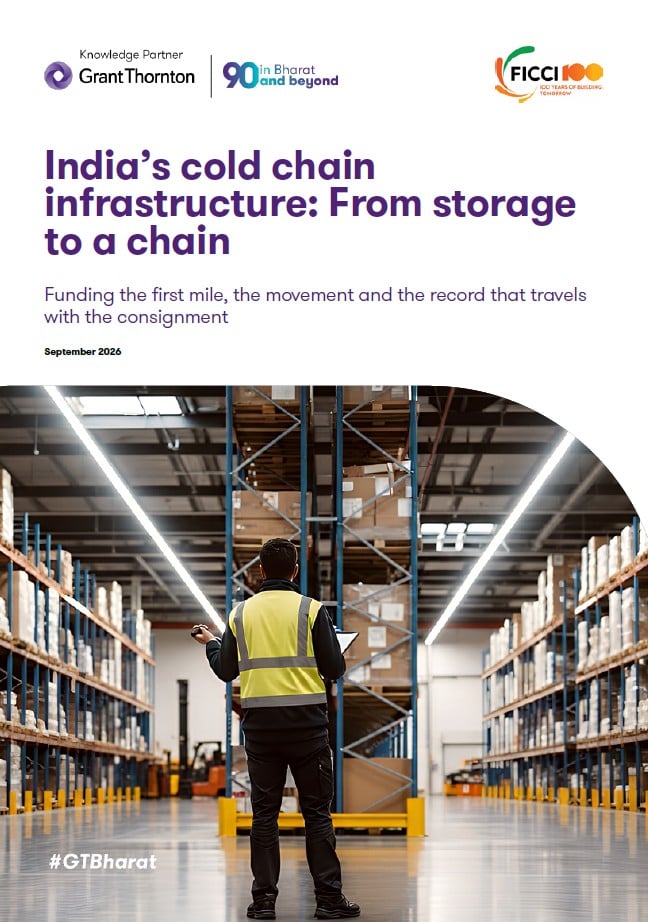
India’s cold chain infrastructure: From storage to a chain

India’s cold chain infrastructure: From storage to a chain

Funding the first mile, the movement and the record that travels with the consignment